Disaster and Crisis Recovery
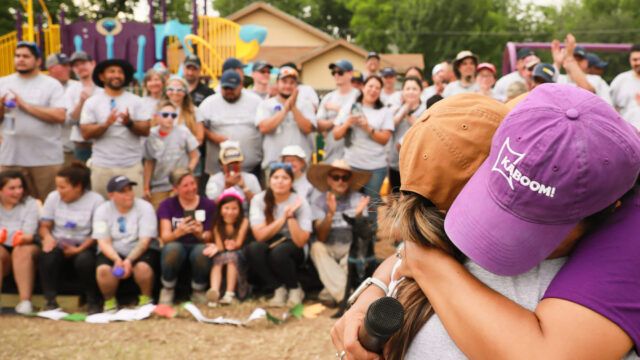
Photo credit: La Vida es Bella Photography
When Hurricane Katrina devastated the Gulf Coast, KABOOM! launched Operation Playground to help rebuild communities through play. Following the first Playground Build Day, just 100 days after the storm, KABOOM! channeled more than $27.1 million, mobilized more than 44,000 volunteers, and built 174 playspaces to bring play back into the lives of 294,000 kids in the Gulf Coast communities hardest hit after the storm. Since then, we’ve continued to support communities across the country impacted by natural disasters and other community crises to help rebuild playspaces and restore normalcy for thousands of kids.
Prioritizing Play
Following a disaster or crisis in their community, children are especially vulnerable to experiencing significant stress and trauma. This is especially true when combined with the loss of routine and normalcy stemming from disruptions to homes, schools, and social connections. This stress not only impacts their mental health and emotional development but can also take a toll on them physically. Children who experience frequent or prolonged levels of this toxic stress can have lifelong health consequences that disrupt or impair their healthy child development.
Research has consistently shown that play has a profound impact on a child’s physical, mental, and social development. In the presence of childhood adversity, such as a disaster or community crisis, play becomes even more critical as part of the healing process. Play allows children to cope with their changing surroundings and experience a sense of normalcy. It builds and strengthens relationships with others and provides a healthy outlet to relieve stress and anxiety. When a child is surrounded by supportive and caring adults and mechanisms, such as play, that provide buffers to their stress responses, children are better able to “bounce back” emotionally and physiologically. However, response efforts often fail to take into account this critical aspect of recovery for children.
Helping Kids in Kerrville, Texas Play
Kerr Kids was born in the aftermath of the devastating July 4th flooding along the Guadalupe River in Kerrville, Texas. Rising waters destroyed nearly everything in its path, including playgrounds, splash pads, biking and hiking trails, leaving children without the spaces that once brought joy and comfort. Kerr Kids began as an immediate relief effort, creating opportunities for children to gather, play, and heal in the face of loss. What started as temporary play days quickly revealed a much bigger need: a permanent play space where kids could rebuild resilience, find comfort, and simply be kids again. KABOOM! granted an Imagination Playground to Kerr Kids to ensure consistent access to a high-quality play experience in the new space.
Community Healing in Uvalde, Texas
In 2022, the City of Uvalde and KABOOM! partnered on a playground project at DeLeon Park to support community healing and provide a sense of hope for the Uvalde community following the tragedy at Robb Elementary School. The creation of the new playground, which is located just blocks from the school, was a community-led process that elevated the voices of children in the community, who shared creative ideas for their dream playground at a series of design events. The project and its groundswell of support from other city agencies and local organizations show what is possible when partners and communities come together to address the needs of kids, especially in times of tragedy. The DeLeon playground project was the beginning of along-term partnership with the City of Uvalde to build more playspaces to ensure every kid has a joyful place to play.
Aftermath of Moore, Oklahoma Tornadoes
After a series of tornadoes devastated Moore, Okla., KABOOM! partnered with the school district and local nonprofit organizations to build playgrounds in areas impacted by the storms. This included a church that was opened as a temporary school for displaced students and the rebuilt Plaza Towers Elementary School, where seven students perished in the storm. That emotional project, which included a tribute to the seven students, was critical to community and child healing.
How We Support Communities
Immediate Response
Working with a strong network of partners, KABOOM! has the knowledge and experience to respond effectively when communities are in need. Working with on-the-ground, nonprofit partners, KABOOM! deploys pop-up play systems to provide immediate play opportunities for kids impacted by disasters or a community crisis. These systems are uniquely well-suited for community partners such as libraries, community centers, shelters, afterschool centers, childcare centers, and schools – as they often play a critical role in providing housing or activities for kids in crisis. These sets are also ideal in situations when outdoor play is not possible due to environmental conditions.
- Imagination Playground- Suitable for children and youth ages 2-18, Imagination Playground is an innovative portable play system that encourages critical thinking, creativity, communication & collaboration. A collection of custom-designed, oversized blue foam parts, Imagination Playground provides a changing array of elements that allow children of all ages to experience creative and active play as they constantly build and re-build using their imaginations.
- Rigamajig- This collection of wooden planks, wheels, pulleys, nuts, and bolts is a large-scale building kit for children designed for hands-on free play and learning. Rigamajig allows children ages 5-18 to follow their curiosity through play while developing STEM skills. Building with this simple set of parts helps children combine imagination with cognitive thinking & invention.
Long Term Recovery
Whether traditional structures or innovative nature exploration areas, playgrounds are one of the few shared community spaces designed specifically for kids, and are an essential tool for their physical, mental, and emotional well-being, especially following a natural disaster or community crisis.
KABOOM! knows first-hand that creating and reopening playspaces is a uniquely powerful way to boost momentum for other recovery efforts, promote community healing, and create a sense of normalcy for kids and adults alike. Research shows that visible efforts to rebuild — particularly those that are neighborhood-initiated and led — are helpful to survivors recovering after a disaster or crisis.
KABOOM! playspaces are created using a community-build model that centers child and community feedback in the design and planning process and harnesses the incredible, positive power of volunteers to transform the new space. It starts with a community design event and culminates in a large-scale service day where volunteers work side by side to build the new playspace and other site enhancements. Children are empowered to have a say in the design of their new playground, which provides a much-needed sense of connection, belonging, and ownership.
Rebuilding playspaces with volunteer engagement can also help communities heal, bringing people together in common purpose to make a difference for kids. The process of restoring a key neighborhood gathering place brings a renewed sense of community and normalcy to children and families – where social linkages are strengthened across generations. It also provides a positive outlet for those who want to help meaningfully contribute to rebuilding efforts.