
Thirty years in, and our work has never been more necessary or more urgent. The challenges facing children today are real: a mental health crisis deepening by addiction to screens, communities starved of safe places to play and belong, and a policy environment that too often forgets our collective responsibility to protect the sanctity of childhood.
But here is what thirty years has taught us: people want to do right by kids, and they know the power and joy that comes from working together. When you give them a real way to do it (a shovel, a community, a purpose), they show up. And when they do, something changes, in the neighborhood, and in themselves. This is the work that makes us so proud of our legacy, and what we know is ahead.
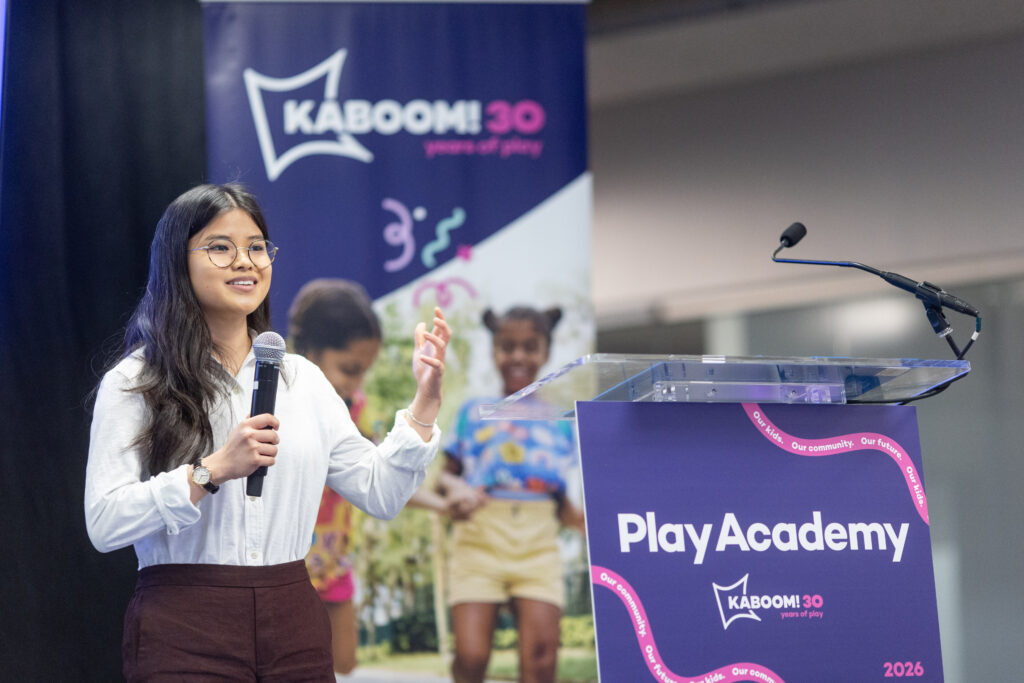
At Play Academy, our annual staff retreat, we heard from several young leaders. One was Isabel Sunderland (pictured on the right), a young advocate who has testified on Capitol Hill and at the White House, holding Big Tech accountable for what it does to children. She described watching her own algorithm serve up apps that distorted her face, then tips for cutting body fat, then worse, a childhood shaped by systems designed to profit from her vulnerability. She is not alone.
Diagnoses of anxiety and depression among children have risen nearly 30% in recent years. Nearly 40% of high school students reported persistent sadness or hopelessness last year, and 1 in 5 seriously considered suicide. The U.S. Surgeon General has warned that 95% of teens are on social media, nearly a third using it almost constantly, and the CDC has linked that directly to the crisis unfolding in real time. Our kids are being commodified. Not as future citizens. As attention. As data. As advertising inventory.
-
Nearly 30%
Rise in depresson among children
-
Nearly 40%
of high school students report persistent sadness or hopelessness last year
-
1 in 5
high school students have seriously considered suicide
That’s where we draw the line.
Our kids should be outside. Playing with each other and fully free to experience the joys and benefits of their very brief and precious childhoods. We are proud that our work gives our kids this foundation, and we love experiencing the joy that all of us get to experience while doing it. We build spaces where kids laugh, dream, and connect. But the reason we do this work is serious. The American Academy of Pediatrics is unequivocal: play is not frivolous. It enhances brain structure and function, builds executive function, and when play and safe relationships are missing, toxic stress disrupts a child’s development. In the presence of childhood adversity, play becomes even more important. In thirty years, we have engaged more than 15 million people to build or improve more than 17,000 playspaces, not by going into communities to observe or advise, but to build alongside them, with children, families, and leaders at the table. Leaders from every sector show up, roll up their sleeves, and discover something together. That is not an accident. It is how we work, by design.
And we don’t stop at the build. We fight for the policies that make play possible in the first place. We have advocated for the PLAY Act at the federal level. We are advancing mandatory recess legislation because research confirms that recess improves self-regulation, attention, peer relationships, and social well-being, and evidence suggests it may even help close the achievement gap between low and high-socioeconomic status students. We have invested in the tools that tell us where playspaces need investment, and we use them to push for investment in the very communities that have experienced decades of disinvestment or neglect. This is systems change work, built on thirty years of trust.
Play is not a luxury. It is not a developmental supplement. It is the thing, the actual thing, that makes kids human and neighborhoods whole. It is the antidote to a childhood spent staring at a screen designed to diminish you. A great playspace doesn’t just give children somewhere to go. It gives them back something the digital world keeps trying to take: their bodies, their imaginations, each other, themselves.
The digital crisis is real. The playspace inequity crisis is real. The opportunity for us to come together to demonstrate our ability to solve important problems is happening. KABOOM!, thirty years in, is rising to meet all three. We know what it takes. We know what’s possible.
This year, we are asking more of our community. Whether you volunteer, fund our broader work, advocate for kids where you live, or help bring others into our mission, this moment calls for all of us to show up boldly for this and future generations of kids, and there is a role for you to join in the movement.
Key Moments in the History of KABOOM!
-
Beginnings of KABOOM!
KABOOM! was founded to make it possible for all kids – no matter their zip code or skin color – to have the same opportunity…
-
What is Playspace Inequity?
Why Ending Playspace Inequity is Important Far too many kids lack adequate places to play due to the ongoing effects of systemic racism. These inequities…
-
Unlocking Possibilities for Every Kid
When people and institutions give to social causes, it’s a form of investing in our shared future and building something meaningful for generations to come.…